Showing posts with label cruising. Show all posts

Wednesday, October 15, 2014

In Retrospect

Not a palm tree in sight.

We are enjoying life on land, with its not-boiling-hot weather (I love fall!!), stand-up refrigerators (no more taking everything out of the fridge for that last piece of cheese), employment opportunities, family fun times and vast floor space perfect for crawling babies. But the transition has not been without some nostalgia.  

For one thing, we had an amazing time. With each other, with our boat and with the ocean. We met tons of new people, made lasting friendships, spoke regularly in a foreign language, hiked through jungles, swam in pristine reefs, learned the sport of spearfishing and lived on the ocean for days at a time with no outside contact except the occasional sea bird or passing dolphin pod. People rarely get to experience such complete solitude or to travel so extensively, bringing their home with them.

And I wish we could have kept going for a few more years, especially up into the Sea of Cortez with its electric blue water and storms of sea life and desert landscape. It just looked incredible, but so it goes sometimes. Even though we didn't travel much this last year, I'm happy that we accomplished something much more important. We were able to stay with our baby, both of us, for almost his entire first year, which is just unheard of normally. You can't get much better than that. 

So without further ado, here are some photos of our trip and beyond. 


And because it just wouldn't be a blog post without some baby pics, here are some photos of Jari since we've been back in the States. I can hardly believe it, but he's almost 1. Just a month and half to go. 


Sunday, May 4, 2014

We Cut the Dock Lines ... Again

A very nice morning in La Cruz.

Right now we are sitting in the most amazing of places, a spot we haven't been to in almost a year. The anchorage. I am currently typing in our cockpit, enjoying a cup of coffee and looking at the sprinkle of boats anchored in the flat calm bay. The pelicans are causing trouble, and occasionally a fish breaks the surface tension. Can you tell that it feels really, really good to be back? 

Before this run, the longest we had ever stayed in a marina since leaving Texas was two weeks at Shelter Bay because my dad was visiting and because of some Panama Canal business, and I thought that was extravagant. If you want to cruise on the cheap, it's obvious that marina's are not the place to be, but we were dealing with atypical circumstances. Nothing like having a baby to stick you on the docks for a few months.

Unfortunately, the main anchorage here in Banderas Bay is kind of crap. It has zero protection and gets super choppy when the winds kick up in the afternoon, which makes for wet dinghy rides. But we're hoping as we travel up the coast we will find more hospitable digs. Even with the chop and roll, we are still liking this life if yesterday evening was any indication. The wind was still gusting, and we all sat in the cockpit as the sun was going down. Vlad and I talked shop, while Jari sat in his diaper playing with a toy giraffe and watching the seagulls dip and dive. There aren't too many better ways to end a day.

Tuesday, March 18, 2014

The Big Decision


And the winner is ... the Sea of Cortez! We will be heading up into the Sea for a couple of months this spring and summer, and we are so looking forward to it. While I've appreciated all this dock time - what with the C-section recovery and the new baby and Vlad working - it will certainly be nice to head back out into the wide open world and actually do some traveling again. Plus, we will get to see a completely different landscape from the usual lush tropical vista. Think fewer palm trees and more cacti.

As for the Pacific, well, it's not going anywhere. We seriously considered just going for it, but Vlad was concerned about getting our boat ready while also working on other people's. There just wasn't enough time. And after watching all of our fellow puddle jumpers, I'm kind of glad we didn't go the super stressful route. We also really want to explore the Sea of Cortez with its small, dusty towns and bare mountains and clear, fish-filled water. If we crossed the Pacific now, we would probably never get come back to see this particular spot.

On the down side, we have heard horror stories about the heat, but we will see how it goes. We will, however, escape at least one of the hellish summer months with a trip to Guadalajara because as it turns out we have to get Jari's birth certificate fixed there. (See our latest paperwork drama here.) They can't amend it in PV. I'm guessing this has to do with the fact that his birth certificate is actually in a file in a stack in the specific office where we registered him, and the whole thing is strictly analog. On a similar note, we did get the baby's American passport (yay!!) last week, and we didn't even have to call our congressmen. The paperwork drama is almost finished.

But our travels with our new crew have just begun.


Wednesday, February 19, 2014

What to Do Next?


I don't usually share the inner workings of my thoughts on the blog, but here lately Vlad and I have been musing about what we want to do and where we want to go next. It's always better to have options, and we've thankfully got a few.

One thought is that we stay here in Mexico for a bit. We could sail in the Sea of Cortez, keep practicing our Spanish and continue living in a country that we totally dig. We love the people here and the food, not to mention that our kiddo is a native. Eventually, of course, we would have to bash our way back up the coast to California, which is a 1,700-mile trip to San Francisco against the wind and the current. You know, pretty much our favorite way to travel.

The other, one might say crazier option, is to make that big leap across the Pacific this year, sail through French Polynesia and end up in New Zealand. From there, we would have the option to sell the boat or do more exploring. This is about a 7,000-mile voyage theoretically with the wind and the waves, but given our track record, well, you never know.

As far as wear and tear on Bettie, I'd say the two choices are both rough. Though doable, the bash up to California sounds pretty crap, and the trip to New Zealand is just plain long with the occasional tough sail thrown in. I can't help but daydream, though, about preparing for and then completing the longest ocean passage in the world, seeing some remote places we might never see otherwise and possibly sailing with the wind behind us for once. Maybe I'm just getting swept up in the Puddle Jump fever that's in high gear around the bay these days, but there's something about it that seems just so enticing.

On the other hand, we really love Mexico, and with the new baby we are a short plane ride away from family. And Jari, for sure, puts a whole new perspective on things. I'm not necessarily scared to be out in the middle of the Pacific with our two month old, but the weight of that decision all of a sudden seems quite heavy. What if something goes wrong and we are 1,500 miles away from land?

It's a lot to digest. Right now, we're just going to continue doing what we're doing - working and getting the boat put together, and when April rolls around, we shall see where we stand. I'm not the only one reconsidering our route. Our friends over at Our Life with Ceol Mor are as well.

Thursday, October 3, 2013

Home Is Where the Boat Is


A good friend of ours commented on our Facebook page yesterday about how "Home is where the boat is," a concept I've been considering recently, and then I started digging through our trip photos and became entranced.

We have been to some incredible places in the past year and a half, places we never would have gone had we chosen a more conventional path. And those photos reminded me not just of the places we've traveled but of the traveling itself. Those days on the ocean with nothing but waves all around us, meals made heeled over 15 degrees (or 25!), books we've read, kites we've flown off the back, dolphins covered in phosphorescence following us like faint green phantoms in the water, the occasional sea turtle and sailfish and stowaway bird, both the storms and the afternoon sun we've dodged and just being so utterly alone away from any of the normal ties that normally bind us to a place.


Anyway, I've been feeling appreciative of our water wanderings, and, yes, it's good to be home. Despite the heat.

Saturday, April 27, 2013

To Acapulco and Back Again

The harbor at Puerto Angel. Never a more welcome sight.

This was our biggest sailing pickle to date. We left Puerto Angel, which is about 200 miles south of Acapulco the Sunday before last and arrived back in Puerto Angel the next Saturday, turning a two-day passage into a week-long slog. Here's the play-by-play of our less than fortunate journey.

Day One: Threw up all day. Vlad sailed the boat.

Day Two: Threw up less. Vlad continued sailing the boat. We are getting close to Acapulco.

Day Three: Vlad informed me that we got stuck in a current the night before. We continue fighting the current. Twenty miles outside of Acapulco, we run out of diesel. I start throwing up again. For real.

Day Four: Vlad was up all night hand steering, trying to make headway. Our tacking angle was almost a straight line, and by midday, we had made 4.3 miles. We radioed the port captain in Acapulco and asked him if anyone would bring us out some fuel. He told us to standby, and that's the last we heard from him. We decided to take a long tack out to sea in the hopes of getting a better angle on our approach to Acapulco. Unfortunately, there was a 20 knot wind blowing out of the northwest, higher than expected waves at 6 to 9 feet and still that vicious current that seemed to stretch all the way to Hawaii. And we were beating against all of it. At this point, Vlad was exhausted and I was wondering why I ever thought a job shuffling papers in a cubicle was somehow unfulfilling. At least an office doesn't move. Plus, we are starting to worry about dehydration. As I am throwing up my last few sips of water into the galley sink, I felt the sun on my back. Vlad had turned the boat around, so instead of going against the waves and the wind and the current we finally just went with them.

Day Five: We made great time at 5.5 knots, and I had almost completely stopped puking. Downwind sailing isn't so bad after all. We were heading to Huatulco where there is a marina, some measure of stability for us and the boat so we could put things back together again. Plus, it was the closest fuel dock.

Day Six: We heard on the radio that the wind in the Gulf of Tehuantepec had picked up to 45 knots, making us nervous about trying to get into Huatulco without an engine. We adjusted our course to Puerto Angel, which is a cute town but a totally unprotected anchorage. We were once again about 20 miles away and the wind died.

Day Seven: Still no wind. We managed to drift within 6 miles of Puerto Angel when Vlad decided to use the dinghy. There wasn't much swell, and he tied the dinghy to the side of Bettie, somehow got our aged, temperamental  6-horsepower Johnson motor going and proceeded to drive us into port using the outboard as propulsion. Though it must have looked ridiculous, it worked pretty well except for the occasional big wave that came through, and then the dinghy would catch some air. Meanwhile he got the engine primed and ready because we did have five gallons of diesel left (it turned out we had more like 25 gallons left in the tank but the seas were so big that air kept getting in the fuel lines), and when we got close to Puerto Angel, he turned on the engine and drove us into the anchorage.

Did I mention that during all of this he took care of me, cooked all the food, washed all the dishes and just generally made sure that we were safe and sound despite the crap circumstances, and all with only 20-minute cat naps for seven days?? Well, he did. He still questions his decision to turn around, adding another 400 miles to our trip when we were within 15 miles from Acapulco, but part of wisdom is knowing when to cut your losses, knowing when to say enough. And we all made it safely to port. No one was hurt. No one had to be air lifted to the hospital, and I finally got some stillness in the form of a hotel room.

Tuesday, September 25, 2012

We Made It

Good morning from Portobelo harbor.

This sounds silly, but I'm always excited when we actually get to the place that we're going. For some reason, it gives me a real sense of accomplishment. Despite everything we encountered along the way and despite the fact that we don't know what we're doing, we still managed to drop our anchor in the exact place we planned on.

The trip from Bocas rocked, plain and simple. It had its share of perfect seas, stormy weather, secluded anchorages, weird wildlife, decent wind (for Panama!), giant container ships and mingling with the locals (spoiler alert: we got mocked by Indians). I'll give you all the details tomorrow.

For now, we're nestled into the harbor at Portobelo, contemplating how to get propane in this sleepy little town. I sense a bus trip in our future.

Wednesday, September 19, 2012

Bye, Bye, Bocas


 We are leaving this morning for the San Blas after almost two months in Bocas del Toro. Staying in one place for a couple of months has given us the time to get a ton of work done on Bettie, but we have also been able to be a part of the community in a way that you just can't when only staying for a week. We've met many of the cruisers in town, the expats and the locals. We know where to get a good, cheap breakfast and have a favorite beach, a favorite beachside bar (Palmar on Isla Bastimentos, we love you!) and a favorite sloth-watching spot.

Nevertheless, we have been itching to move on, to see and explore some new places. Here are some highlights of the upcoming journey - Escudo de Veraguas, an offshore island which is uninhabited except for a couple of Indian families, a few fishermen and a species of three-toed pygmy sloth that's only found on the island; the historic city of Portobello; and crossing the ship channel that leads into the Canal Zone. It should be quite the adventure.

Saturday, September 15, 2012

The Pressure Cooker Revolution


We made potatoes last night in the pressure cooker, and it only took eight minutes. Not 25 or 30 minutes until those delectable tubers were soft enough to mash - only eight. This may not sound like that big of a deal, but not only have I become a lazy cook since moving aboard (who wants to clean up that many dishes in a tiny boat sink?!) but life on a boat is about reduction - fewer clothes, less electricity usage, not as many books. And the pressure cooker helps us save time and propane in a big way, with the added bonus of keeping the boat much cooler while cooking.

Before leaving Texas, I had read a little bit about pressure cookers, and people on boats seemed to have them. However, I hadn't really given it much consideration beyond a general concern about exploding kitchens. Vlad, however, was all for it, and his dad hauled one down for us all the way from the U.S. Now we don't have to spend hours slaving over a pot of beans or 30 minutes cooking rice. The pressure cooker is easy, quick and despite my initial fears Vlad assures me it won't explode. Honestly, I'm not sure why we didn't have one of these when we lived on land.

I want to give big thank you to Vlad's dad for lugging a 4-quart, stainless steel pot for us across international borders. We had a great time during your visit, and the pressure cooker rocks! If anyone is interested in pressure cooker recipes, Rebel Heart has a fantastic list of them, including some fabulous looking risotto. And if there are any other good recipe websites, please let me know.

Friday, September 14, 2012

Cost Control While You Cruise: A Review


Most people's first question when contemplating a long-term cruise is “How much will it cost?” And invariably the answer is a “How much do you have?” But a new film - Cost Control While You Cruise by veteran cruisers Lin and Larry Pardey - gives a more constructive answer to the ever present cash question. They detail how to sail on a budget - tips that range from having an unstoppable boat to how to get the most out of your sails.  

They go through a ton of categories - insurance, communication, haul outs, grocery shopping, buddy boating - but I think their two main points are having a solidly built boat with backup systems in place and enjoying life aboard. If you have backup systems, when your windlass breaks you can still get the anchor up, and if your boat is a comfy home that’s easy to cook, sleep and shower in, then you will save money by not being tempted to head to the marina every time you get a little stinky. They also conducted a 2009 survey of two dozen or so cruising couples and found that budgets ranged from $3,000 all the way down to $700 a month. The average cruising budget was between $1,200 and $1,500 depending on whether the cruiser was American (hint: Americans are the big spenders).

If you've ever seen any of the Pardeys' other work, this film is of a similar fashion. Lin and Larry give advice on how to trim your costs, interspersed with gorgeous shots of them sailing in exotic locales. My only suggestion for them would be to include Skype within their discussion of communication costs. Most cruisers we know use it regularly to call home, and it's either free or ridiculously cheap. We pay $5 a month and are able to make phone calls anywhere in the U.S., which is great especially if you have less tech savvy family members (I'm talking to you, Dad!) who are more comfortable on a phone than on a computer. 

Vlad and I have really been working on getting our budget on track, spending less so that we can see more of this wide world, and Cost Control While You Cruise enlightened us on several ways to save while sailing. But more importantly, it reminded us to pay attention. If we focus on the little details, we can remain, for the most part, in control of our costs. We can choose to go to places off the usual path that are beautiful and amazing with the added bonus of having nothing to buy. We can track down good bulk food at good prices. We can choose to spend money on entertainment or eating out, or we can pick the cheaper option of going to the beach or cooking for ourselves instead. 

I'd like to give a huge thank you to The Sailing Channel for letting us watch this film. It definitely helped with our budgetary woes. If any of you are interested in seeing it, here's a link to download the film or purchase the dvd. 

Wednesday, September 12, 2012

A Life Less Stressful


A couple of weeks ago, I was chatting with a friend of ours at the marina about our respective future plans, and she said that when she and her husband returned to the U.S. for a visit people kept coming up to them and saying that they'd changed, that they were different somehow, more relaxed and happy. I have found myself feeling much the same way - relaxed, happy, not worried or anxious about stuff and pretty darn excited about our travels and the future. All of which got me to wondering, why does this life seem so less stressful than our lives back home?

You could say that it's from not working, but we do work. We work on our boat all the time and on other people's boats on occasion. Granted, it's not the kind of work where you commute two hours a day and toil away in a concrete box under florescent lighting, but it's also not always peachy either. It's hot, sweaty and often times filled with bits of varnish. In addition, we have been traveling in places where we don't speak the language and don't always get every cultural nuance, making for some frustrating situations. Add to that, trying to get parts in foreign countries and dealing with bureaucracy and the pot might boil over, so to speak.

Not to mention, that sailing itself isn't exactly stress free. Squalls pop up. Essential equipment breaks. The wind or the current isn't always in your favor. You have to be able to make good decisions under pressure, to problem solve in a way you rarely would in the suburbs, all while knowing that if you can't figure it out there is probably no one else nearby who can help you. 

And yet, for all that, it's a much more pleasant way to live, and here's my theory as to why. The stressors people are subjected to in the modern world are a constant hum. Small as they may be, there is rarely an escape. When cruising, however, your adrenaline spikes when a squall comes out of nowhere. You reef the sails and get ready. Then in 30 minutes or an hour, it's over, and you go back to staring at the never-ending ocean. When stressors come up, you deal with them, and then they mostly get resolved. But dealing with that morning traffic on a freeway never goes away until you either retire or move to a town with public transportation.

Plus, the pace of life is just plain slower in Central America, and it also helps that we get to be outside all the time with lots of swimming and beachy goodness. So for everyone planning to sail off into the sunset, the experience has brightened my mood and my perspective, and I would love to hear some other thoughts on this topic from other cruisers.

Here's a nice post by S.V. Nyon that touches on a similar theme.

Friday, September 7, 2012

Questions on Cruising


A couple of weeks ago, Dani from Sundowner Sails Again asked me a whole heap of questions in the comments section, and I thought they deserved a full post rather than just a quick response. So, in answer to Dani's questions . . . .

Would you have departed home when you did and taken the route you did?
We had planned on waiting until after hurricane season to leave Texas, giving us more time to work our way down through the Caribbean to the Panama Canal, but instead we decided to go early. On the one hand, that decision was costly because we had to hurry through places in order to beat the heavy part of hurricane season beginning in August. On the other hand, had we stayed, we might have wasted our money on just one more thing (or 20) for the boat or other unexpected expenses and been stuck at the dock for another year or two. We decided that it made more sense to just go, and even though there are downsides to that decision I don't regret it for a second. As to the route we chose, I think it would be fantastic any way you sliced it or diced it - down the Central American coast or through the thorny path and the Eastern Caribbean - either way is pretty incredible. A couple of articles on SailFeed just tackled top cruising destinations - here and here.

Have you had any experience so far where you felt you or Vlad may have gotten hurt or killed?
Not really. Vlad's pinky finger did have that unfortunate encounter with the windless that one time, but other than that we haven't had any really perilous moments. We've been in a few squalls, and we've run aground in sand and mud twice, both of which aren't fun but generally aren't the end of the world either. Obviously, you can get hurt while sailing, and we do take precautions like clipping in when offshore. But I haven't found it nearly as scary as people make it out to be. Then again, we haven't been in a major storm, and we work hard to keep it that way! I would also like to note that we don't take many risks with the weather or sail close to reefs in uncharted water. If it looks at all dubious, we don't go there. Perhaps this limits us, but I would prefer to keep our boat afloat, hole free and out of stormy weather.

If you could redo one part of your journey down there what would it be and how? 
I would stay in Providencia longer. Best island ever.

After cruising for four months, money aside, do you feel now that you want to stay cruising longer than originally planned, shorter, or the same?
Definitely longer! Hands down. We just haven't seen all the stuff we want to see yet. There is so much more to explore, so many more people to meet, weird animals to watch, reefs to snorkel, those gorgeous, picture perfect anchorages to snuggle down in that it's hard to say when we will be ready to move on from this life. Undoubtedly, there will be a moment in the future when we both look at each other and say, that was fun but I'd like to live on land again, but if money were not an object I think that point would be a long time coming.

If anyone else has any questions on the cruising experience, feel free to send them my way.

Monday, August 20, 2012

Things We Love on a Boat

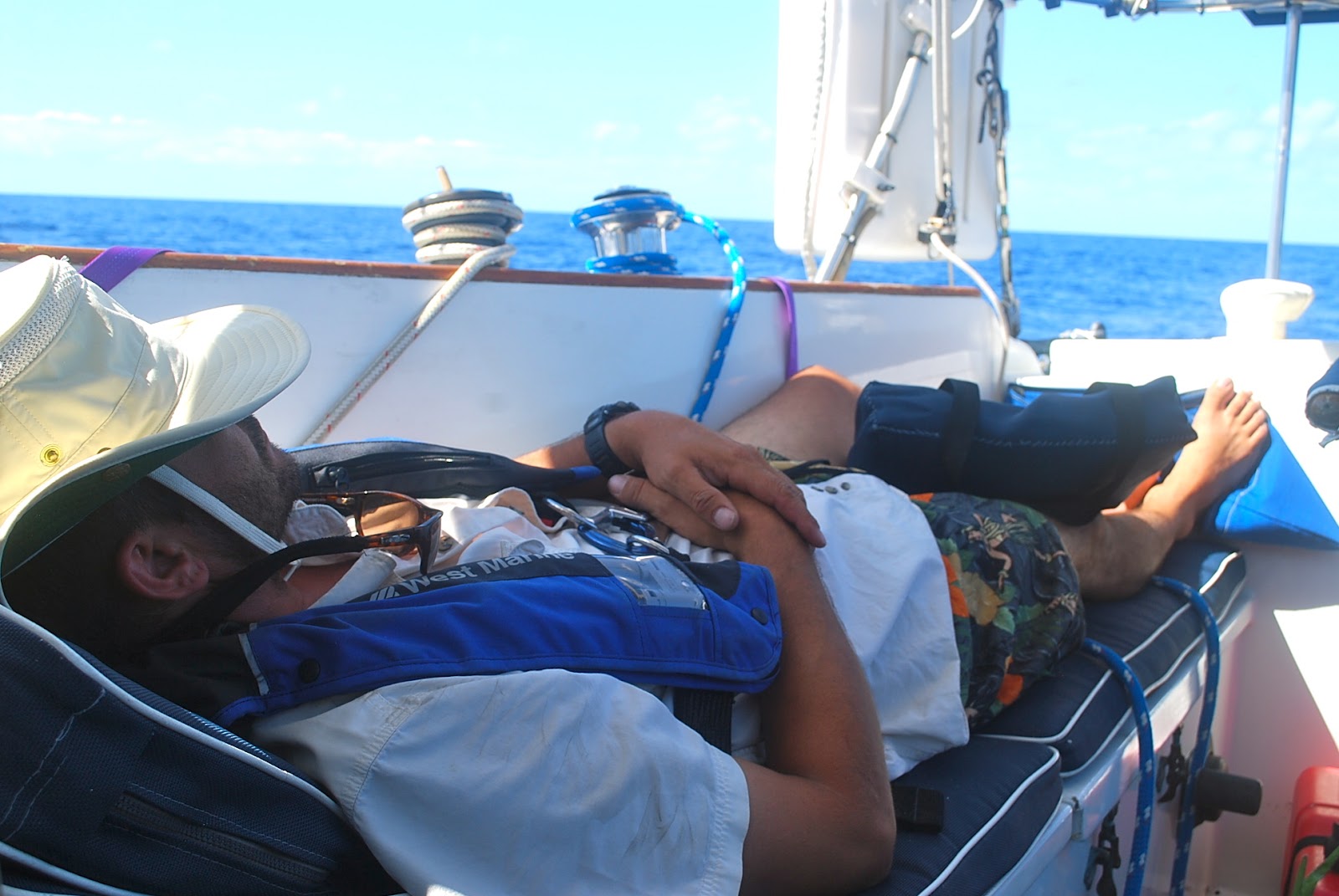
See, we even wear our PFDs while sleeping.

The iPad for navigation: We use Navionics on the iPad as backup navigation, and we've loved it. The display is fantastic, with a ton of detail, and I find it much easier to maneuver than our regular chartplotter. People complain about using the iPad in direct sunlight, but we seem to manage just fine. We have found some mistakes on the maps once we left the U.S., but we also found them on the chartplotter. We generally use it coming in and out of ports or when there is some tricky bit of navigation. Oh, and guess what? Our left-for-dead chartplotter made a miraculous recovery yesterday. The arid Panamanian climate must agree with it.

Sticky back: We have had to patch our mainsail twice now and once was at sea when we tore out one of the second reef points, leaving a substantial hole in the main. Sticky back has been our knight in shining armor in both of these instances. It's basically sail cloth with an adhesive backing that you can slap right on a tear and either patch it temporarily or stitch over it for a more permanent solution. Many thanks to our friends Scott and Natalie who gave us a few yards right before we left Texas. Without it, we would have had to turn back to the coast instead of making it to Florida. Here's some sticky back from Sailrite.

The internet: Having the internet on the boat rocks. True, sometimes it's fun to sip a tropical fruit smoothie while typing away on the blog in some coconut tree fringed cabana bar, but it has been very handy to have the internet on the boat while at anchor. Our set up includes an antenna, a wireless router and a bullet, which is smaller router that attaches to the antenna. With these three items, we can pick up wireless signals from up to five miles away. We occasionally even find pockets of free service, but don't count on it in the Western Caribbean, Mexico being the only spot where we found free service consistently. We are talking about getting a cell phone card that will double as a hot spot for our further travels down the coast of Panama, and we will let you know how that fares.  

Reusable ice cubes: On a boat, sometimes the smallest thing makes a big difference. Vlad's dad gave us a pack of reusable ice cubes before we left, and they have been pretty darn useful, especially on hot tropical days when all you want is a cold glass of water. There are many types, but here are a few examples on Amazon.

Our safety gear: We have a couple of rules on Bettie, and probably the most important one is don't fall overboard (unless the man-overboard box pushes you!). I can't even imagine what it would be like for Vlad to wake up and find that I am not on the boat or vice versa. The thought makes me shudder. For that reason, we both are clipped in at all times when we are offshore or if we are in rough water. We wear a combined harness and personal flotation device (PFD) with a tether attached to either jacklines or a heavy steel clip in the cockpit. And, yes, the PFD is hot, heavy and leaves some pretty silly tan lines, but there is no way we would ever leave without them.

A smorgasbord of dry bags, Ziplocs, etc: We have multiple sizes of dry bags, from the tiny, clear plastic kind to a large backpack that Vlad likes to fill with heavy stuff and then walk around for several miles. Don't ask me why, but he seems to enjoy it. Obviously, life on a boat is a potentially wet existence, not a great place for sensitive electronics or cameras, but having a wealth of dry bags helps keep them safe. Also, we left with a disturbing amount of Ziploc bags - from gallon size to quart - which have been handy for all sorts of stuff, and we wash and reuse them to conserve.

Vlad's coconut machete: In Providencia, he bought a special machete, one that has a bendy blade just for cutting up coconuts. He loves this thing and managed to make friends with a group of Colombian tourists by cutting up coconuts for them. The little kids were especially pleased, and being a major coconut aficionado, I'm pretty pleased with it myself! Just remember to be careful with your fingers.

The Cuban yo-yo: This simple spool of fishing twine is a must for lazy fisherpeople like ourselves. We just toss it overboard and wait for a nice, fat tuna to bite or at least something to steal our bait. It really passes the time. Plus, you can make one out of pretty much anything. We saw little girls in Mexico fishing by wrapping fishing line around plastic water bottles, basically the same concept as a Cuban yo-yo. We also have a speargun that we keep meaning to go fiddle around with, but we always just snorkel instead. The fish have been spared for yet another day.

Each other: I'm sorry for the extreme cheesiness, but it's true. In many ways, it is an incomparable gift to be able to spend so much unconstrained time with the person that you love - to explore places and see all of these things and talk to all of these people with one another. Most people spend the majority of their days never getting a chance like this. And I won't say that it isn't hard sometimes because it is. And I won't say we never get into fights because we do. But each day we get to be curious about the world around us and satisfy our sense of adventure and watch every single sunset together. Plus, Vlad gets the honor of keeping me safe from Moray eels and making me read about sea cucumbers, while I make sure he gets plenty of quiche to eat. I feel pretty darn lucky every day.


Thursday, August 16, 2012

Stuff We Wish We Had Brought Cruising

We love our books, but a Kindle would be great too!

Happily, this list isn't all that long, but there are a few items that we wish we had squeezed into our boat with a shoehorn before we left Kemah.

A generator. As I mentioned in a previous post, we have a bit of a power issue down here in Panama. We can't get the batteries charged up through the solar panels because there isn't any sun, and though we have a broken wind generator that some lovely cruisers gave us a couple of weeks ago there also isn't much in the way of wind in Bocas. So we are forced to run our engine, which is bad news. It puts precious hours on the engine unnecessarily, is a waste of fuel and is unfortunately loud, not the set of circumstances I was expecting when we left Kemah all happy and almost totally energy efficient. We had presumed that we wouldn't need a small, gasoline generator given our solar panels, so why spend the extra $400. Now, I see that the extra $400 is worth it given the wear and tear on the engine, the price of diesel and the health of our batteries. Being able to run a small genny for just a few hours when our batteries get low would make a major difference.

A Kindle. Perhaps this is too analog, but I've always been a book person, preferring the feel and smell of a newspaper or a book stolen from my dad's library to the electronic copies all the kids are into these days. That is, until we moved onto a boat. I had assumed that I could replenish my book supply through the exchanges in various marinas, but unfortunately, unless you have a penchant for bad fiction, the pickings are slim. Both Vlad and I have learned the hard lesson that once you've read one Tom Clancy book, you really aren't interested in reading another. So I've taken to reading decent books on my computer or iPad, but they both use a lot of power. Not to mention that the iPad is our sole navigation source now that the Raymarine chartplotter gave out in a rainstorm somewhere in the Gulf Stream outside Isla Mujeres (we are getting charts for our handheld as a backup). The Kindle, bless its little heart, solves all my reading woes. It holds a charge for forever, isn't an integral part of our navigation system and only costs $80.

A new outboard motor. OK, so maybe just some outboard motor parts. Shockingly, we left the United States without any spare parts for our ancient 6-horsepower Johnson motor, which turned into a major kerfuffle when the impeller died a tragic death in Roatan. Our intrepid friend Matt brought us plenty of extras when he came for a visit, but now the pull cord apparatus has decided to leave us forever. I'm sure Vlad could fix it, but what both of us would really like now is a 10-horsepower outboard that doesn't break every five minutes and that I can start. A reliable outboard that can cover a decent amount of water on a plane is an ideal that we have come to very much admire, and for me personally having the ability to start the motor would be nice. Vlad worked for a fellow cruiser who in return gave us a small, 2.9 horsepower Mercury motor that we dubbed the Mighty Mouse. I can start that sucker on the first pull and go wherever I please. Ah, sweet freedom.

A gun. This is one of those subjects that you don't want to bring up on any of the sailing forums, cause people get all - dare I say it - up in arms. But it is a wild, wild world out there, and it's good to have some way to protect yourself. We have bear mace, flares and a speargun, but nothing says go away like the sound of chambering a shotgun. True, traveling with guns can be a major hassle, especially through Mexico (where it is illegal and if they catch you they will take your boat), and, of course, having a gun doesn't mean that you are safe. But it is pretty good protection and an excellent deterrent.

Quick drying shorts. Life on a boat is wet. It rains. There are waves. The dinghy ride is especially treacherous. Currently, we only have shorts that are made out of cotton, the typical Target or Old Navy variety, and they just refuse to dry. A couple of pairs of shorts made from some sort of magical synthetic substance that dries quickly would solve this problem. Getting away from water is impossible, but drying off doesn't have to be.

Wednesday, August 8, 2012

What About That Hedgehog?


Some people have been wondering how Sid Vicious is liking our new life at sea. He seems to enjoy it about as much as he enjoys anything else, which is to say not at all. Pretty much his only loves are cat food, cheddar cheese and being angry. He used to love snuggles until we got to the tropics. Now, he prefers lying on the floor with his tummy pressed onto the cool floorboards and refuses to be held.

 
For an undocumented hedgehog, it has been surprisingly easy to get him in to foreign countries. Before we left, I was terrified that we would be turned away from ports or that officials would force Sid into some dank, dark quarantine room for months, which, come to think of it, he probably wouldn't mind that much.

But all in all, he seems down with boat life. I doubt he would even try to escape. Or would he . . . ?


Tuesday, August 7, 2012

Cruising: The Beautiful


To make up for all the "bad" stuff I talked about yesterday here are a bunch of photos from our trip that show how the good outweighs the not so nice. Every time we look at the photos we've taken, it is a reminder of how lucky we are to have done this - heat rash and all.


Monday, August 6, 2012

Cruising: The Bad

It's really hard to find a picture of the not-so-nice parts of cruising.
 
The heat or the humidity. I knew it was bad when Vlad started mentioning how much he'd like to see penguins. I told him there were penguins on the equator. Next, he said, "You know, we should really stay away from polar bears." I said, "Okay...." Then, he said, "You know where the farthest place away from polar bears is?" "Where," I asked. "Antarctica." He's also stated that it's ok if we want to turn back now - "we can make it to Connecticut in a couple of months." So, it's hot. But what does that mean exactly? Lots of sweating, for one. The kind that just doesn't go away, the kind that makes you want to take a shower every 30 minutes, the kind that makes Vlad sweat through three shirts in a day and the kind that gives you heat rash. From the heat and subsequent sweating, Vlad and I both have gotten skin rashes that I try to get all Florence Nightengale on with the witch hazel and tea tree oil. It works sort of, but it's a constant battle. Sometimes, we go stand in air-conditioned ATM boxes just for some relief. Paradoxically, since we've moved south, the heat has dissipated substantially, but the super wet Panamanian climate will no doubt bring new delights. Leprosy, perhaps?

The ocean. Ok, so this one is a bit tongue and cheek, but we were surprised at just how uncomfortable it is sailing on the big wide blue. Those nice protected sailing waters like Galveston Bay are not the norm, and conditions in the open ocean are rarely optimum. The waves are large and often on our beam, making for a very unpleasant motion. The winds are often too high or from the wrong direction or nonexistent. Romantic notions of ocean travel abound, and, yes, there is beauty in every direction out there. But it's also a harsh and unforgiving landscape, one that bashes you about, covers you in bruises and makes it impossible to boil water in a regular pot.

Mold and mildew. I have now cleaned mildew off of our shoes. I've cleaned mildew off of my wooden cooking spoons. I've cleaned mildew off of our cooler and washed it out of my clothes. And this stuff is not shoved in some drawer somewhere (well, some of the clothes were). It's out in the open, getting plenty of air, and still the stuff spreads like crazy. As I mentioned in a previous post, leather is the worst. Vlad has lost two pairs of shoes and a wallet. Another cruiser we know lost a watchband. I have a bad feeling this particular battle will never end and that we will lose. Badly.

Things breaking. Things break on a boat. Even brand new things that you've only used a few times. If you're not ready for this fact, then boat life might not be right for you. Yet, things don't just break on a boat. They break. Then, Vlad fixes them, and then the same stuff breaks again right after he fixes it. Example: The outboard's impeller shattered. Vlad replaced it, and then the pull cord apparatus chose that moment to also break. I don't know why I find this so infuriating, since Vlad does all the work (stoically and without complaint, I might add), but it drives me nuts. I'm blaming imps.

Naysayers. Negative people are everywhere, but sailing seems to have a very vocal contingent of folks who say, "You can't do that." In fact, we've been told variations on that sentiment enough that it's almost kind of comical. And if it's not "you can't do that," it's some iteration of "you should be afraid." Very, very afraid. Then, we go off and do whatever it is that you can't do and find it not only doable but not scary in the least. My personal favorite has been the hurricane discussion. We would meet someone who asked us about our hurricane plans. We would tell them, and they would then proceed to lecture us on how our plan of heading south until we got out of the hurricane belt was very risky and not a smart move. But here's the kicker. I would then ask them where they were going for hurricane season, and they would reply, Florida. Or Texas. Two of the most hurricane prone places in the U.S. See how at this point we just want to laugh? Here's an insightful post on the whole fear mongering thing from The Excellent Adventure, and if you are planning on going on an excellent adventure of your own, absolutely ask questions and be prepared and get advice, but do not listen to the naysayers.

Not having enough energy. Energy usage on a boat is a balance of charge and draw, and we seem to tilt the scales on the power out side. We use computers, a fridge/freezer and the radio, run a wireless router so that we get the internet on the boat and turn on fans at night so that we don't sweat ourselves into dehydration in the dead calm Panamanian heat. We have three solar panels that should provide most of our power, but unfortunately Panama has a lot of cloud cover, rendering our panels pretty much useless. We have acquired a broken wind generator that Vlad may be able to fix, but there's also not a ton of wind in Bocas. We are now considering buying a small gasoline generator so that we don't have to run the engine, something we should have done before we left the U.S. We attempt to conserve, but there's only so much that can be done if we want to keep such luxuries as fans and leftovers.

Money. It's been way more expensive that we had originally thought, but not in the ways we had figured. Now there are reasons for that, which I will get to in a later post, but basically we had assumed that Central America would be cheap, cheap, cheap. But prices for things that cruisers use have doubled, from what we can tell, in the past five years. Checking in to Providencia, for example, used to be a few bucks not that long ago. Now, it's $120. We thought that stopping at a marina would be really cheap in these places. Not so. Nor is diesel. Nor is food always less than in the U.S. Here in Bocas, food prices are on par with the U.S., except for vegetables. Hence, our new found love of red cabbage. Last month, we spent nearly $800 on diesel and checking in to Panama and Providencia - $320 on diesel and $424 on check in fees. That is close to what I had budgeted for the month all on two items and doesn't include food, the occasional sightseeing adventure, transportation, boat parts and water.

In conclusion, sailing has not been what we've expected. It has exceeded our wildest imaginings. We've seen a waterspout dip from the sky and phosphorescence dance on the water. We've met wonderful people along the way who have enhanced our lives and have been given the freedom of movement, if only for a couple of years. Yet, we have also been unpleasantly surprised. Cruising can be frustrating. Sometimes there are no simple solutions. Occasionally, the people we have met have been less than friendly. Though we would never, ever, ever take back this incredible experience, we would have been able to deal with some of these items a bit better had we planned for them. Things such as buying a small Honda gas generator or choosing a route with less expensive check-in fees or researching the best way to deal with mold and mildew before it started growing between our toes (just joking, I swear!). Some things you can only understand by experiencing them - like, in true masochistic fashion, learning to enjoy the ocean kicking the crap out of you - and some things it's good to hear about beforehand - like the fact that cruising is expensive in ways we hadn't planned on.

Perhaps some people out there have some thoughts on the positives and negatives of cruising. If so, I'd like to hear them. 

Thursday, August 2, 2012

Cruising: The Good, the Bad, and the Beautiful


For exactly four months today we've been out on the ocean, seeing new spots in our own country and new countries altogether, all while fixing the boat, exploring every day, and most importantly trying to take photos of uncooperative chickens and massive iguanas. As I said in a previous post, we've sailed at the record-shattering speed of four miles an hour and have traveled nearly 3,000 miles, about the same distance it takes to get from New York to California. And we've been getting questions from our friends and family about how it's going. Do we love it as much as we though we would?

So I thought I'd devote the next few posts to answering the question of what we've loved and what we haven't. Vlad says to always start on a positive note, so tomorrow you get all the good stuff. And if you just can't wait until then, here's what the folks over at The Adventures of Tig and Serena had to say about their first month of cruising.


Thursday, July 26, 2012

Dolphin Bay


We took Matt down to Dolphin Bay and anchored in a lagoon about 10 miles away from Bocas Town. We went on a dinghy ride around the lagoon, skirting the edges of the dripping rainforest and the mangrove islands through which local fishermen paddled dugout canoes, and saw a ray do a double axel right out of the water.


After eating a nice meal of green chili cheeseburgers, we spent the evening listening to howler monkeys and watching a distant lightning storm brighten the horizon, and once the monkeys went to sleep, it was completely quiet and completely still. Until, of course, Vlad jumped into the water.

True to its name, Dolphin Bay actually had about 20 dolphins swimming and leaping and playing in the water. Panama is really putting on a show for Matt.

Thursday, July 19, 2012

We Made It to Bocas del Toro


And we actually made decent time - think, six to seven knots. That's never happened before! We are both a little on the sleepy side (I've been up since 2:00 a.m. dodging thunderstorms - slow ones, with lots of lightening - and Vlad doesn't sleep much at all during crossings), but we will give you the scoop on life in Bocas and the crossing from Providencia as soon as we recover.

Our anchorage

We are still sad, though, about leaving Providencia, so there will be a few "retrospective" posts to come.